How to spot an AI-cloned voice in under a minute
AI voice cloning now needs only a few seconds of audio. Here's the plain-English checklist for verifying a panicked “family emergency” call — plus the technical signals our detector uses behind the scenes.
Why voice cloning is suddenly everywhere
Until recently, faking a person's voice convincingly required studio gear and hours of recordings. In 2024 that changed: consumer AI tools can now clone a voice from 3–10 seconds of audio — the length of a TikTok caption or a voicemail greeting.
Scammers grab a short clip from a social post, generate a panicked message, then call or send a WhatsApp voice note. The story is almost always the same: lost phone, car crash, urgent bail money, hospital bill, gift cards needed right now.
Knowing what to listen for — and what to do in the next 60 seconds — is the difference between a near-miss and a five-figure loss.
The 7-step verification checklist
If a call or voice note feels off, walk through this list before sending money, sharing data, or clicking a link.
- 1
Pause. Real emergencies survive a 60-second pause. Scam scripts don't.
- 2
Hang up and call back on the number you already have saved.
- 3
Ask the family safe-word — or any detail only the real person would know.
- 4
Listen for unnatural breathing, missing micro-pauses, or robotic prosody.
- 5
Refuse all unusual payment methods: gift cards, crypto, wire to a new bank.
- 6
Tell a second person before sending money — scammers isolate their target.
- 7
Record the audio (where legal) and run it through a voice-clone detector.
What our voice scam detector actually checks
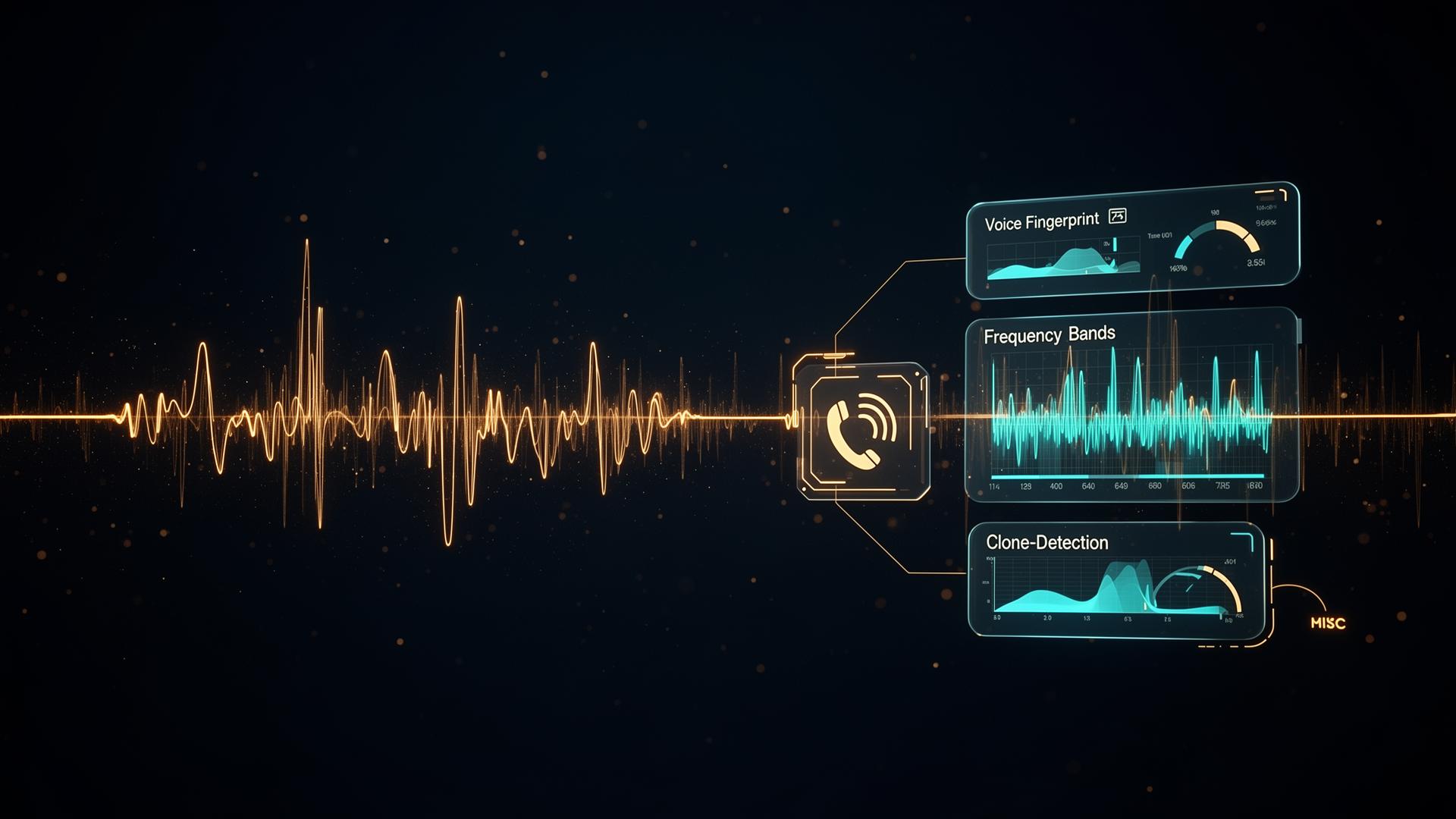
Behind the simple Trust Score, four families of signal do the heavy lifting. Each one is weak on its own; together they're hard to fool.
AI vocoders leave repeating patterns in the higher frequencies that natural voices don't have. Detectors compare the spectrogram of your clip against known synthesis signatures.
Human speech is full of tiny breaths and 0.05–0.2s pauses between words. Cloned voices often skip them or place them in unnatural spots — a strong tell.
Voice cloning tools resample audio at fixed rates. When that signal gets wrapped into a WhatsApp or phone codec, it leaves measurable distortion that real recordings don't show.
Most family-emergency scams follow a small set of scripts: lost phone, car crash, bail money, hospital bill. Pattern recognition flags the language, not just the audio.
Red flags to listen for
- • Call comes from an unknown number, not their usual one.
- • They demand money, gift cards, or crypto immediately.
- • They tell you not to call anyone else — especially not police.
- • Their story doesn't match where you know they actually are.
- • They hang up when you offer to call them back on their saved number.
- • Flat or robotic emotional range, even mid-panic.
- • Breathing that doesn't match the words being spoken.
- • Words clipped at the edges, or strange micro-silences between syllables.
- • Background noise that loops or cuts in and out unnaturally.
- • Voice quality changes between sentences (recorded in chunks).
Set a family safe-word tonight
The single best defence against voice cloning is a safe-word your immediate family agrees on. Pick something specific — not your dog's name, not your street — and use it as a challenge any time someone calls in a panic.
- Choose a word or short phrase no one outside the family would guess.
- Don't write it down where photos or backups could leak it.
- Agree: no safe-word = no money, no exceptions, no matter how urgent it sounds.
- Refresh it once a year, or after anyone in the family loses a phone.
If you think you've been targeted
If money has been sent in the last few hours, call your bank's fraud line immediately. Many transfers can be recalled.
Call them on a number you already have, or a trusted third party who can reach them in person.
In the US: report to the FTC (reportfraud.ftc.gov) and FBI IC3. In the UK: Action Fraud. Reporting helps shut down the scam ring.
Frequently asked
How accurate are AI voice cloning detectors?
Modern detectors catch most off-the-shelf clones, but no tool is perfect. Treat a detector result as a strong second opinion, not a verdict. Always confirm with a call-back on a known number.
How much audio does a scammer need to clone a voice?
As little as 3–10 seconds of clean speech is enough for many consumer voice-cloning tools. A short TikTok clip, voicemail greeting, or Instagram story is plenty.
Can I trust caller ID?
No. Scammers routinely spoof caller ID to show a familiar name or number. The displayed number is not proof of identity.
What's a family safe-word?
A short phrase only your immediate family knows. If someone calls claiming an emergency, ask for the safe-word before doing anything. Real family members will know it; an AI clone won't.
Should I record the call to check it later?
Yes, if it's legal where you live. A recording lets you upload the audio to a detector and review it with someone you trust before acting.
Got a voice note you're unsure about?
Upload the audio — we'll check it for AI voice cloning signals and known scam scripts in under a minute. Free, anonymous, no account needed.
Check a voice note now